Update: Spacedrive has since pivoted to v3 — a local-first data engine that indexes any data source and makes everything searchable from one place. The v2 code lives on through the v2 branch on GitHub.
Three years ago, I open-sourced Spacedrive with an ambitious vision: build a file manager that blurred the lines between devices and clouds. In a world where your data is siloed, unorganized, and living on someone else's servers, it felt overdue to change that with open source... and Rust.
We released an alpha that saw over half a million downloads, and the repo became the 30th most-starred Rust project on GitHub. We even raised $2m USD from OSS Capital, Naval Ravikant, Tobias Lutke and Tom Preston-Werner.
But it couldn't connect your devices. At its core, it was still just a file explorer.
By early 2025, we were running out of time. The team had grown to twelve people, yet we still didn't have a working sync engine or a realistic business model. Updates stopped, we fought hard to make it work, but without complete tech or a sustainable business, it wasn't enough. I lost the team, but not the belief in the vision.
For the past six months, I've been rewriting Spacedrive solo. Armed with years of architectural thinking and the clarity of hindsight, I rebuilt the entire system, using the original codebase as a reference for both what worked and what didn't.
I don't just mean a file manager. I mean a complete Virtual Distributed File System — and this time it's actually distributed. A leaderless sync protocol. Peer-to-peer device connections. Support for every major filesystem, cloud provider, and operating system. This is a private cloud stack packaged into a file explorer.
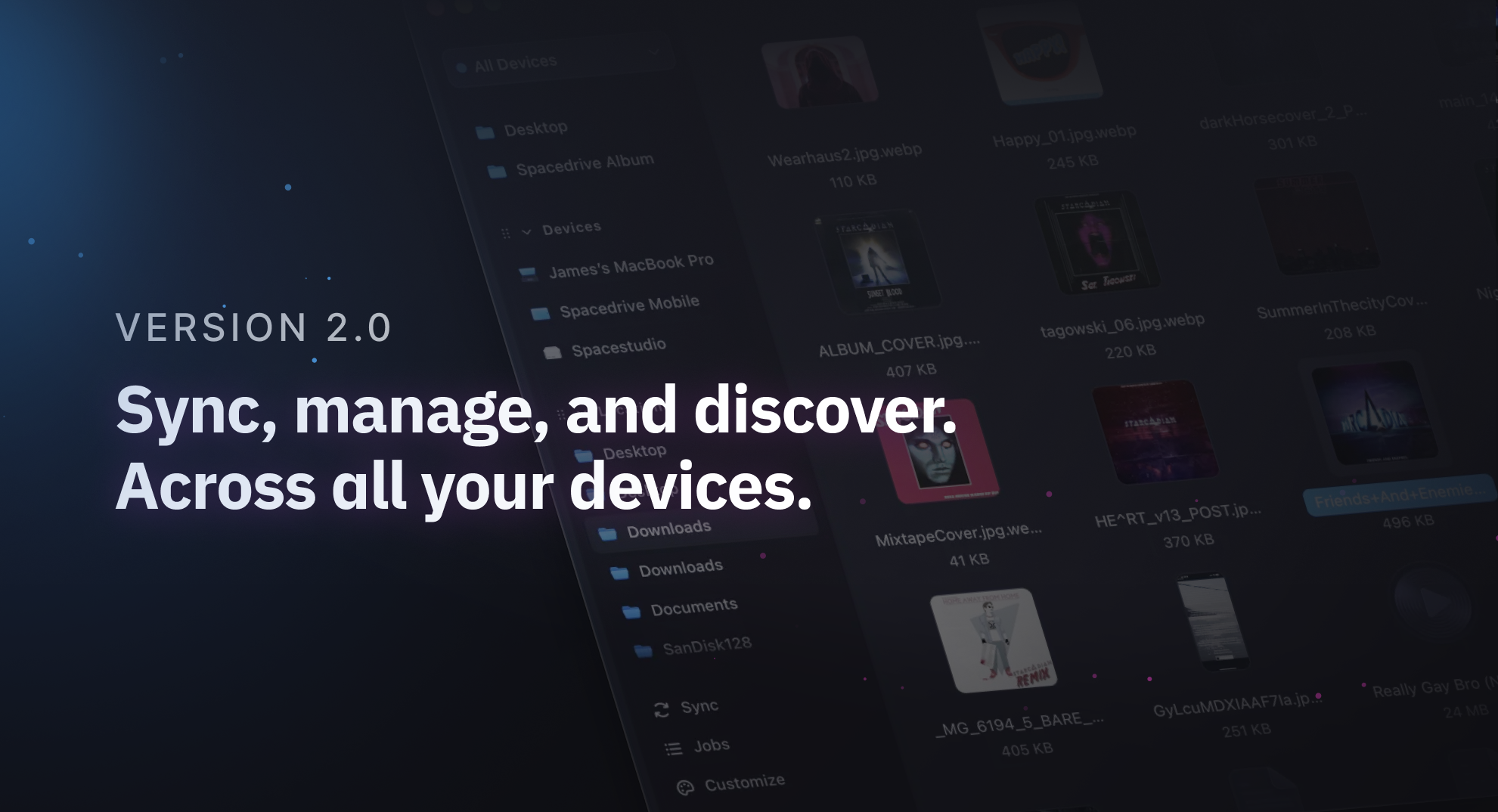
Today I'm shipping v2.0.0-beta.1. It runs on macOS, Windows, Linux, iOS (TestFlight), and Android (beta). You can download it right now.
As for the business model: the core remains free, open source, and self-hostable forever. With the new SDK, I've built six premium extensions that transform Spacedrive for niche markets. Studio turns it into a powerful digital asset manager. Ledger, an accounting tool. Atlas, a flexible CRM. More to come.
And today, I'm also launching Spacedrive Cloud, already complete with team support. Add Cloud Cores to your fleet of devices for extra compute and storage only when you need it. From file sharing to public hosting, all cloud functionality is built directly into the open core and can be entirely self-hosted.
The open-core platform provides the primitives for true multi-device computing, wrapped in the most familiar interface in existence — the file explorer.
Jamie
Under the Hood
For those who care about the details: 183k lines of Rust. 50+ integration tests. Full documentation coverage. A multi-node test suite that spins up real devices. A complete CLI. A GPU-accelerated media viewer. The whitepaper documents everything: content-aware addressing, transactional actions, the leaderless sync protocol. Read it at spacedrive.com/whitepaper.